A request for “ASTM B505 aluminium bronze” is incomplete until it identifies the alloy, casting process, delivery condition and inspection evidence. By the end, you will know how to resolve the B505–B148 label conflict, compare casting routes, specify a custom ring or sleeve, and judge whether a Delhi quotation is genuinely comparable.
Key takeaways
- Confirm ASTM B505/B505M covers the required continuous-cast product form.
- Separate B505, B148 and alloy designation AB1 before requesting prices.
- Compare chemistry, tensile results, dimensions and certificates—not alloy names alone.
- Give every Delhi supplier the same drawing, quantity and inspection plan.
What ASTM B505 actually specifies—and why the casting process matters
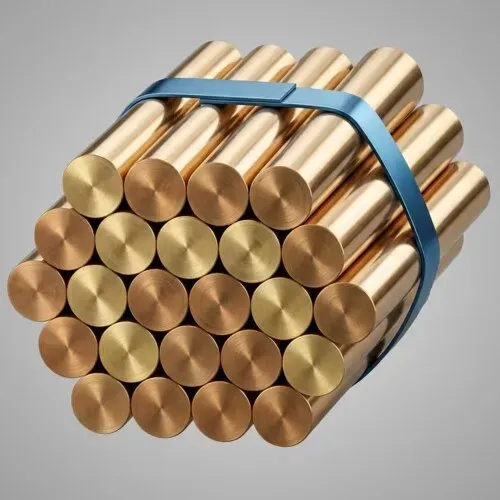
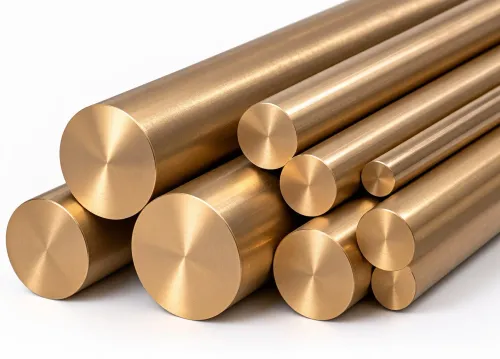
ASTM B505/B505M covers copper-base alloy continuous castings, not every aluminium-bronze casting. The applicable edition defines permitted product forms and dimensions, alloy designations, chemical-composition limits, mechanical-property requirements, sampling, test methods and acceptance provisions. Product forms such as bars and tubes apply only where that edition lists them.
“ASTM B505 aluminium bronze” is therefore not a universal description for every casting method. A separately poured ring, bush or sleeve is not proven B505-compliant because it uses aluminium bronze or resembles a B505 continuous-cast tube.
| Process | Directly relevant specification | Manufacturing route |
|---|---|---|
| Continuous casting | ASTM B505/B505M | Metal solidifies continuously into bar, tube or another listed form |
| Sand casting | ASTM B584 | Mould is filled for an individual copper-alloy casting |
| Centrifugal casting | ASTM B271/B271M | Rotating mould produces an annular casting |
For ASTM B505 aluminium bronze for castings in Delhi, put the process on the drawing and make the supplier identify the governing standard on the inspection certificate.
- Write “continuous cast,” “sand cast” or “centrifugally cast” beside the part description; do not leave the route implied.
- Name the required B505/B505M edition, product form, dimensions and UNS alloy on the purchase order.
- Ask for a certificate linking the casting to a heat or lot, with the ordered chemistry and any required tensile, yield, elongation and hardness results.
- Reject a certificate that calls a sand or centrifugal casting “B505” without explaining the standard’s applicability; request ASTM B584 or ASTM B271/B271M documentation when that process governs.
Resolve the B505, B148 and AB1 identification problem before ordering
Treat an ASTM B505 title that also cites ASTM B148 and grade AB1 as an unresolved identification issue, not as proof that one standard covers the other. ASTM B148 specifies aluminium-bronze and other copper-alloy sand castings; ASTM B505/B505M concerns copper-base alloy continuous castings. These are not interchangeable labels.
| Standard or term | What it identifies | What you must confirm |
|---|---|---|
| ASTM B505/B505M | Continuous copper-base alloy castings | The ordered part is continuously cast |
| ASTM B148 | Sand-cast aluminium-bronze and other copper-alloy castings | Whether it governs the supplied casting |
| AB1 | A designation needing a documented cross-reference | The exact UNS chemistry and applicable edition |
Ask the supplier to state in writing whether B148 is the governing casting specification, a material reference, or an additional requirement. An ASTM B505 aluminium bronze quotation remains incomplete until the purchase order names the UNS alloy: C95200, C95300, C95400, C95500 or, where included by the applicable edition, C95800.
AB1 alone cannot confirm chemistry or equivalence.
C95400 contains approximately 10–11.5% aluminium and 3–5% iron, with copper making up the balance apart from specified minor elements. Nickel-aluminium bronze C95800 is different: nickel changes its phase balance, corrosion behaviour, strength and heat-treatment response. Therefore, a generic “aluminium bronze” quotation is technically incomplete, even from an ASTM B505 bronze casting supplier.
Compare alloy chemistry, properties and certificates—not brochure claims
Evidence is a heat analysis or mill test certificate that names the ordered UNS grade, links the casting to a heat or lot, and reports aluminium, iron, nickel, manganese, copper balance and impurity limits against the exact ASTM B505/B505M edition. A chemical certificate alone does not prove mechanical compliance.
If mechanical properties are specified, request separate tensile strength, yield strength, elongation and hardness results. The report must identify the test method, specimen condition, sampling location and orientation.
| Grade or standard | What the evidence means | What it does not prove |
|---|---|---|
| ASTM B505 | Continuous-cast copper-alloy material meeting the stated edition and UNS chemistry | Compliance of a separately sand-cast or centrifugal-cast part |
| ASTM B148 | Sand-cast aluminium-bronze and other copper-alloy casting requirements | Equivalence to B505 continuous-cast material |
| ASTM B150 | Wrought aluminium bronze, with wrought processing and properties | Cast-metal performance |
| C95400 | Aluminium bronze with about 10–11.5% aluminium and 3–5% iron | C95500 or nickel-bearing C95800 chemistry or properties |
| C95500/C95800 | Different chemistry and phase balance; nickel in C95800 changes corrosion, strength and heat-treatment response | Transferable C95400 values |
Never copy a C95400 brochure value onto C95500 or C95800. Continuous-cast, sand-cast and centrifugal-cast results are not interchangeable because solidification, porosity and grain structure differ.
Visual examination cannot establish internal soundness. Add radiography, ultrasonic testing or sectioning to the order when pressure retention, sealing, fatigue or heavy loading makes shrinkage, gas porosity, oxide films or inclusions critical; an ASTM B505 bronze casting supplier should state the method and acceptance criteria.
Choose the right route for a custom ring, bush or sleeve
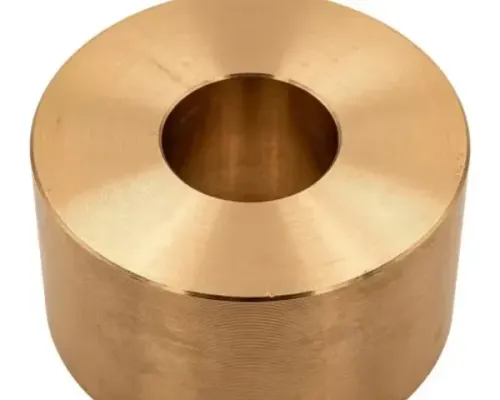
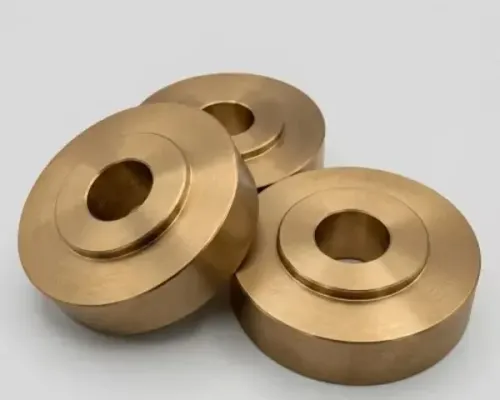
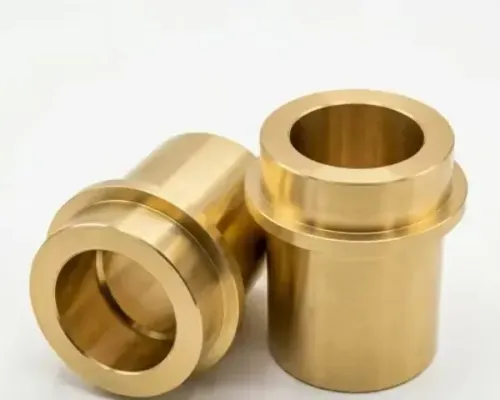
Centrifugal casting is the practical choice for a ring, bush or sleeve when a sound annular section, controlled bore and repeat production justify the tooling and setup cost. It is not automatically the best route for a one-off part.
| Route | Choose it when | Main trade-off |
|---|---|---|
| Centrifugal casting | Rotational geometry and repeat quantities | Requires setup and machining control |
| Sand casting | Complex external geometry, integral features or low quantities | More variable section soundness and finish |
| Forging | Wrought grain flow and demanding load paths govern | Limited shape freedom and higher tooling |
| Wrought tube, bar or plate | Small quantities, tight dimensions and predictable material matter | More machining and material waste |
Your drawing should state:
- Finished inside diameter, outside diameter, length and wall thickness
- Bore and sealing surfaces, with concentricity and roundness limits
- Machining allowance, as-cast tolerances and permissible local wall variation
Approve the as-cast drawing and machining route before production. Distortion, shrinkage or a thin local wall can consume the stock needed to finish a bearing bore or sealing face. A stock B505 bar or tube tolerance does not define a custom near-net-shape casting.
A search for astm b505 aluminium bronze for castings in delhi does not settle the process or specification. Ask whether the part is continuously cast, sand cast or centrifugally cast, then match the certificate to that route.
Build a comparable Delhi quotation and inspection plan
A comparable quotation starts with a complete technical brief, not “ASTM B505 aluminium bronze.” For ASTM B505 aluminium bronze for castings in Delhi, require every bidder to state:
- UNS grade and governing ASTM standard
- Continuous, sand or centrifugal casting process
- Finished and as-cast dimensions, tolerances and machining allowance
- Quantity, heat-treatment condition and machining scope
- Hardness method, tensile test, yield test and specimen details
- Non-destructive examination, acceptance criteria and report format
- Certificate format, heat or lot traceability and Delhi delivery point
| Quotation item | Comparable basis | Warning sign |
|---|---|---|
| Process | Continuous, sand or centrifugal | Process omitted |
| Weight | Finished weight, as-cast weight and recovery yield | Price based only on nominal casting weight |
| Inspection | Chemistry, tensile, yield, hardness and agreed NDE | Chemical certificate only |
| Commercial scope | Tooling, machining, heat treatment, packing and delivery | Exclusions left vague |
There is no meaningful universal astm b505 aluminium bronze price per kilogram. Copper and alloying-metal prices, casting weight versus finished weight, yield and scrap recovery, pattern or tooling, machining, heat treatment, testing, packaging and Delhi delivery change the total. Compare like for like.
Ask each astm b505 bronze casting supplier to name the standard printed on the inspection certificate and disclose the actual process.
Kamal Deep Metal Works Pvt Ltd is a Delhi source to include when checking copper-alloy casting and machining capability, provided its quotation documents the ordered alloy, process and inspection basis rather than relying on a catalogue label.
Related product
 | Aluminium Bronze Grade AB1 Product Type Ring Weight Per Piece Up to 1 kg Casting Method Centrifugal Usage/Application Marine Hardware Standard ASTM B148 Finish As... View product → |
Frequently asked questions
What does ASTM B505/B505M specify for aluminium-bronze castings?
It specifies requirements for copper-base alloy continuous castings, including listed product forms, dimensions, alloy designations, chemical limits, mechanical properties, sampling, test methods and acceptance provisions.
How do ASTM B505, ASTM B148 and AB1 differ?
ASTM B505/B505M covers continuous castings, while ASTM B148 covers sand castings. AB1 is an alloy designation, so it does not identify the casting process or replace the applicable ASTM product specification.
How should you choose a casting route for a custom ring, bush or sleeve?
Match the route to the part geometry, required length, machining allowance, quantity and performance needs. Continuous casting suits listed bar or tube forms; sand casting suits one-off or complex near-net shapes.
What should a comparable Delhi quotation include?
Send the same drawing, alloy designation, ASTM specification and edition, casting route, quantity, tolerances, machining allowance, testing, inspection documents and delivery terms to each supplier.
Keywords